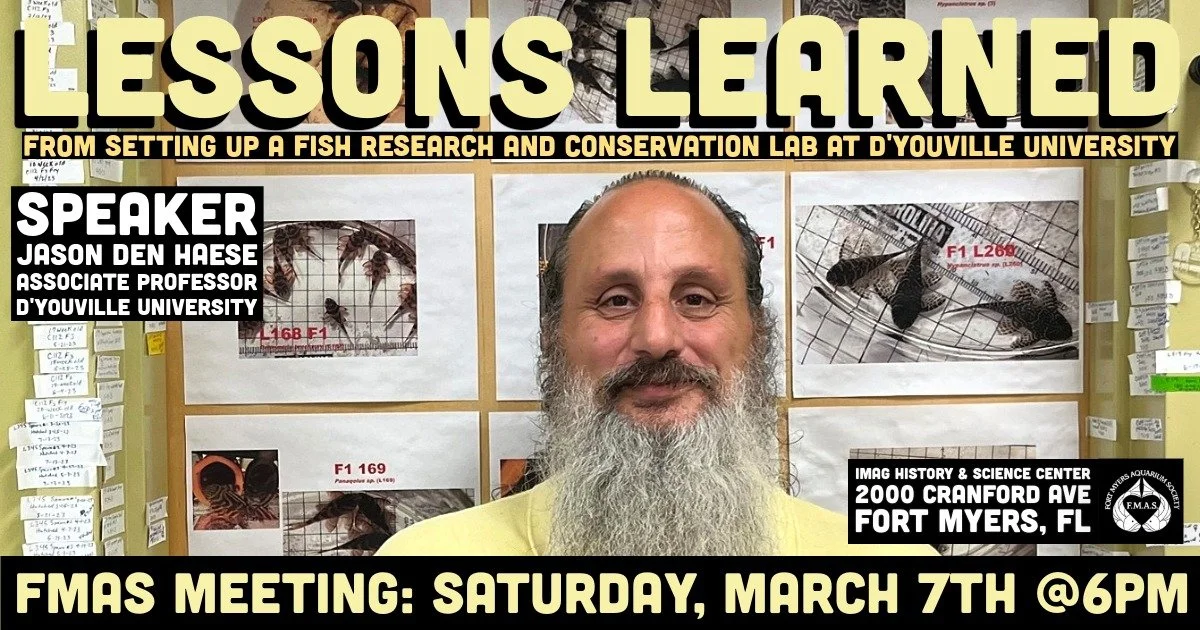
Lessons Learned from Setting up a Fish Research and Conservation Lab at D'Youville University
Presented by: Jason Den Haese
Talk Description: In this presentation, I will share the process of building my fish research laboratory at D’Youville University, beginning with its inception in January 2020 and continuing to the present. I will discuss the challenges encountered along the way, how I worked through them, and the lessons that shaped the development of the lab. I will also highlight a number of meaningful successes that emerged as the work progressed. To conclude, I will share photographs of several of my L-number pleco breeding groups and their fry, and provide updates on our ongoing research initiatives.
Speaker Bio: I have a strong and diverse research background acquired from experience in industry, clinical, and academic settings. In industry, I served as the director of gene cloning and research at IMMCO Diagnostics Company where I used my training in molecular biology, microbiology, immunology, and biochemistry to produce two new products for diagnosing autoimmune disease in patients in just under three years. In a clinical research setting, I spent 13 years working at Roswell Park Comprehensive Cancer Center (RPCCC), focusing on cancer prevention and leukemia. In an academic setting, I began teaching at D’Youville University (DYU) in the Department of Natural Sciences and Mathematics in 2009. For the next decade until 2018, I worked in two full-time positions, one at RPCCC and the other at DYU.
In 2020, I started my own research program at D’Youville University working with fish from the armored catfish families; Loricariidae and Callichthyidae. The natural habitat of these fish is the Amazon River Basin of South America. I maintain over 100 tanks in my fish research lab. My research focuses on the breeding, growth, and survival of armored catfish fry. To date, I have spawned and produced fry from 32 different species spanning 9 different genera from Loricariidae and 7 different species spanning 4 different genera from Callichthyidae.
In addition to this research, I am also interested in fish conservation. My conservation work focuses on establishing captive breeding groups of wild fish that have been listed as near threatened (NT), vulnerable (VU), endangered (EN) or critically endangered (CR) on the International Union for Conservation of Nature’s (IUCN) red list of threatened species. Species with these designations could become extinct in the wild. I have established breeding groups for Hypancistrus zebra (CR), Peckoltia compta (EN), Leporacanthicus joselimai (VU) and Ancistomus wernekei (NT). If, or rather, when these species on the IUCN red list become extinct in the wild, fry from my captive breeding groups can be made available to both scientists and hobbyists.
My passion for this research is only rivaled by my passion for teaching, service to others, and devotion to my family. I strongly believe in giving back to those in need and am actively involved in volunteering at both DYU and the greater community. When I am not at DYU, I spend time with my wife Charlene, and my seven children, Erick (32), Jason Jr. (29), Summer (28), Chloe (25), Luke (22), Blake (19) and Brody (17).
Fish and Plant Auction
Don’t miss our huge fish and plant auction after every meeting!
There’s a huge variety which changes every month.
More Information
Join FMAS for a more advantageous seller split!
Questions? Use the contact form below.