Hurricane Preparedness
By Rick Borstein, Fort Myers Aquarium Society
Introduction
Hurricane activity and attendant loss of power in our area of Florida (Fort Myers and Cape Coral) should be a significant concern for aquarists:
Hurricane Irma (2017): 85%+ of Lee County lost power. Restoration took 7 to 14 days.
Hurricane Ian (2022): Near 100% blackout. Full restoration took 2 to 4 weeks.
Hurricane Milton (2024): Over 200,000 Lee County customers lost power. Restoration took 3 to 7 days.
Loss of livestock can occur in unaerated tanks quickly, sometimes in less than 24 hours.
After a power loss, care should be taken when restarting filters. For example, canister filters deprived of oxygen can quickly generate toxic hydrogen sulfide in two hours or less and require immediate attention during a power outage.
As a responsible Florida aquarist, you should take steps to protect your fish and aquatic animals in the event of a hurricane or other significant power outage.
Considerations
Your approach to power outage management may depend on several factors:
Number of tanks
Size of tanks
Location of tanks
E.g. Spread throughout your home or in a dedicated fish roomStocking level of the tanks
Cost
Filter types in use
Your goal is to keep your fish alive for the duration of the power outage. That means maintaining adequate aeration to maintain oxygen levels for your fish.
Adequate aeration does not mean constant aeration. Intermittent aeration – between 30 and 50% of the duration of the outage – is generally sufficient to keep your fish alive and well.
Do not concern yourself with powering lights or other non-essential accessories.
Next, we’ll review various solutions and how you might implement them.
Some Florida homeowners have invested in whole home backup generators from companies like Kohler or Generac. These units provide enough backup power for your entire home.
Many residents own generators which run on gas or propane.
Generators are great options, but are out of scope for this article.
Drip Aeration Method
A simple method to add aeration to a tank when the power is out is the Drip Aeration Method. By slowly dripping water into the aquarium, surface agitation increases oxygen levels. A second benefit relevant for Florida is reducing tank temperature through evaporative cooling.
Drip Aeration Diagram
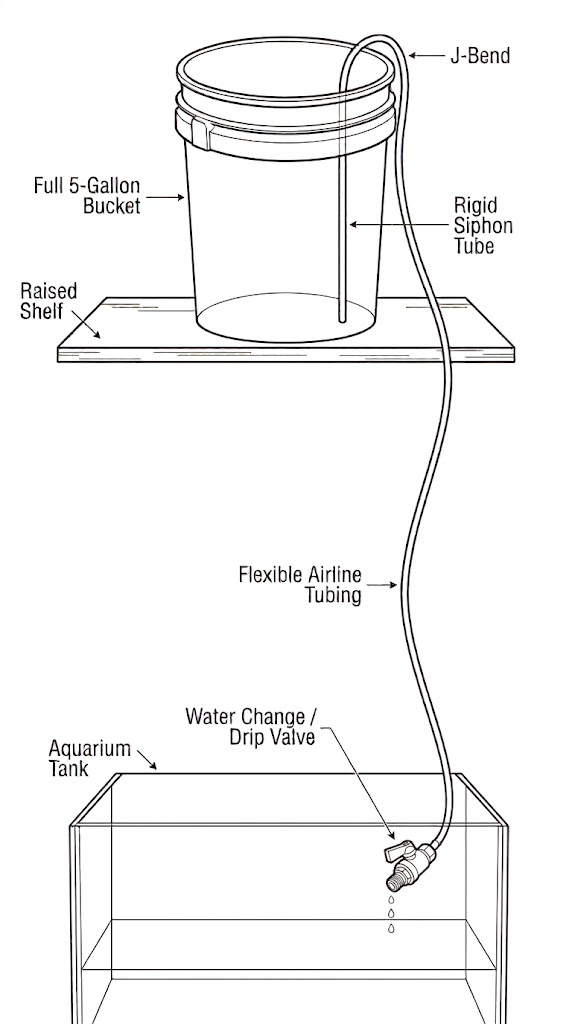
Note: Not to scale
Creating Your Own Drip Aeration Set-up
Here’s what you’ll need:
Rigid aquarium tubing about 18” long
Airline tubing
Plastic Air Valve
5-gallon bucket
A one foot piece of 14ga electrical wire
Step 1: Create a J-Tube
Insert the 14ga electrical wire into the rigid aquarium tubing leaving two inches hanging outside.
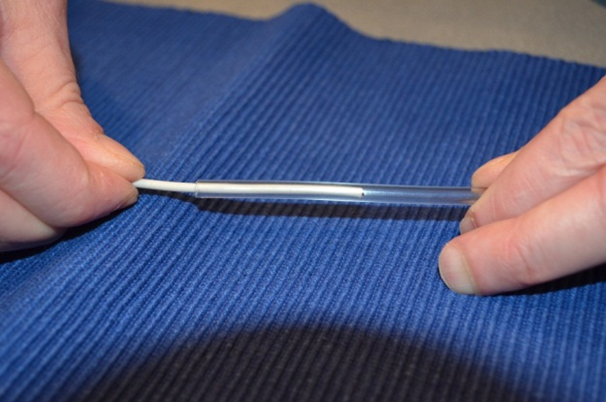
Use a heat source to bend the tubing (gas burner on stove, lighter, etc.) and slowly bend the tubing so that the long leg of the tubing is 14-15 inches.
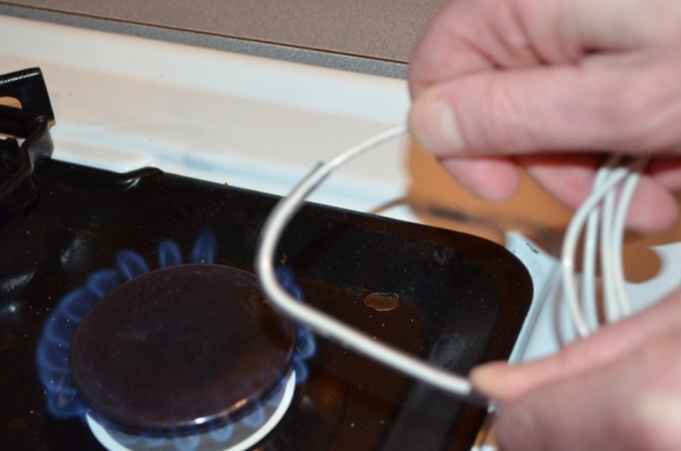
Slowly remove the electrical wire from the bent tubing preserving the bend and avoiding kinks
Allow the J-tube to cool.
Attach the airline to the short leg of the drip tube.
Insert the air valve into the end of the airline.
Step 3: Set-up the drip system
Fill the bucket with water from the aquarium.
Place the bucket on a secure, strong shelf above the aquarium level.
You could use a ladder or table as long as it is above the water level
Insert the long leg of the J-tube into the bucket.
Open the air valve.
Use suction to create a siphon.
Adjust the drip rate via the valve to about one drip per second.
Secure the valve in place to ensure water goes only into your aquarium and not your floor.
Drip Aeration Method Notes
At a rate of one drip per second, you can expect 8-10 hours of aeration from a 5-gallon bucket.
A 5-gallon bucket weighs about 45 pounds, so ensure that the shelf, table, etc. used to elevate the bucket is secure.
USB Pumps, Power Banks and Power Tool Batteries
USB (Universal Serial Bus) connectors are generally associated with phones and computers, but today there are many USB-powered aquarium accessories such as air pumps, filters and more.
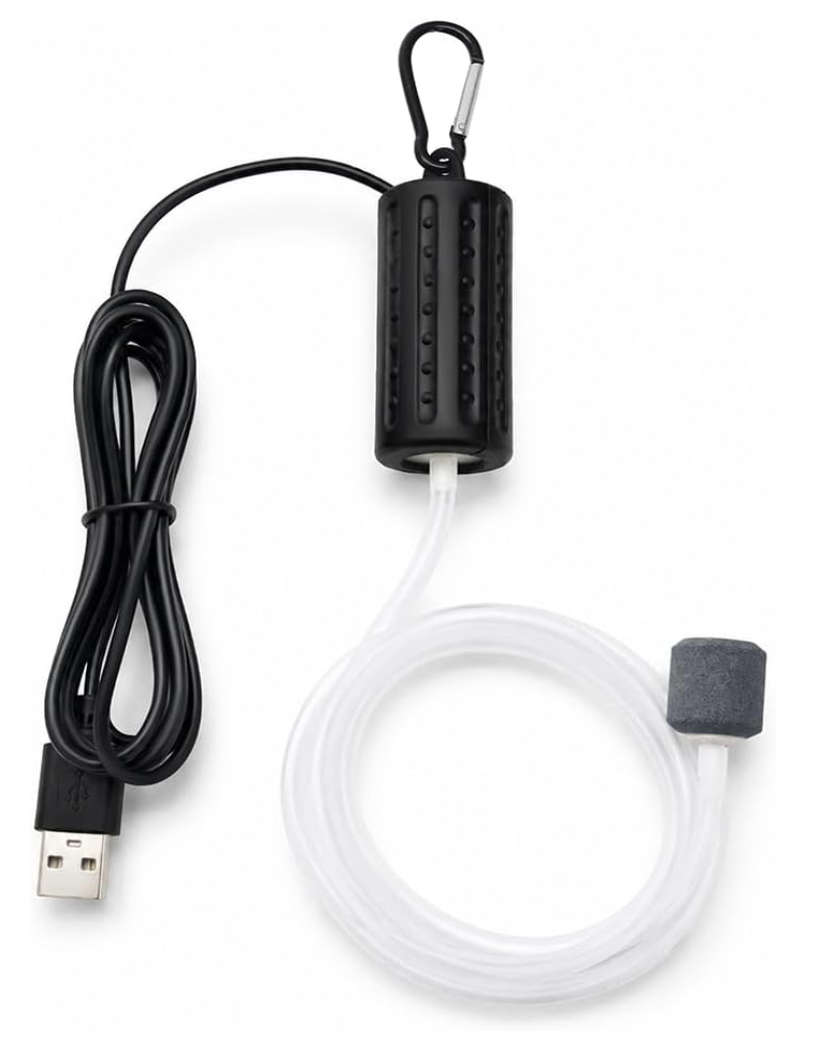
A USB Air Pump which uses 1 watt of power
USB powered aquarium devices open up many opportunities for backup.
USB Power Banks
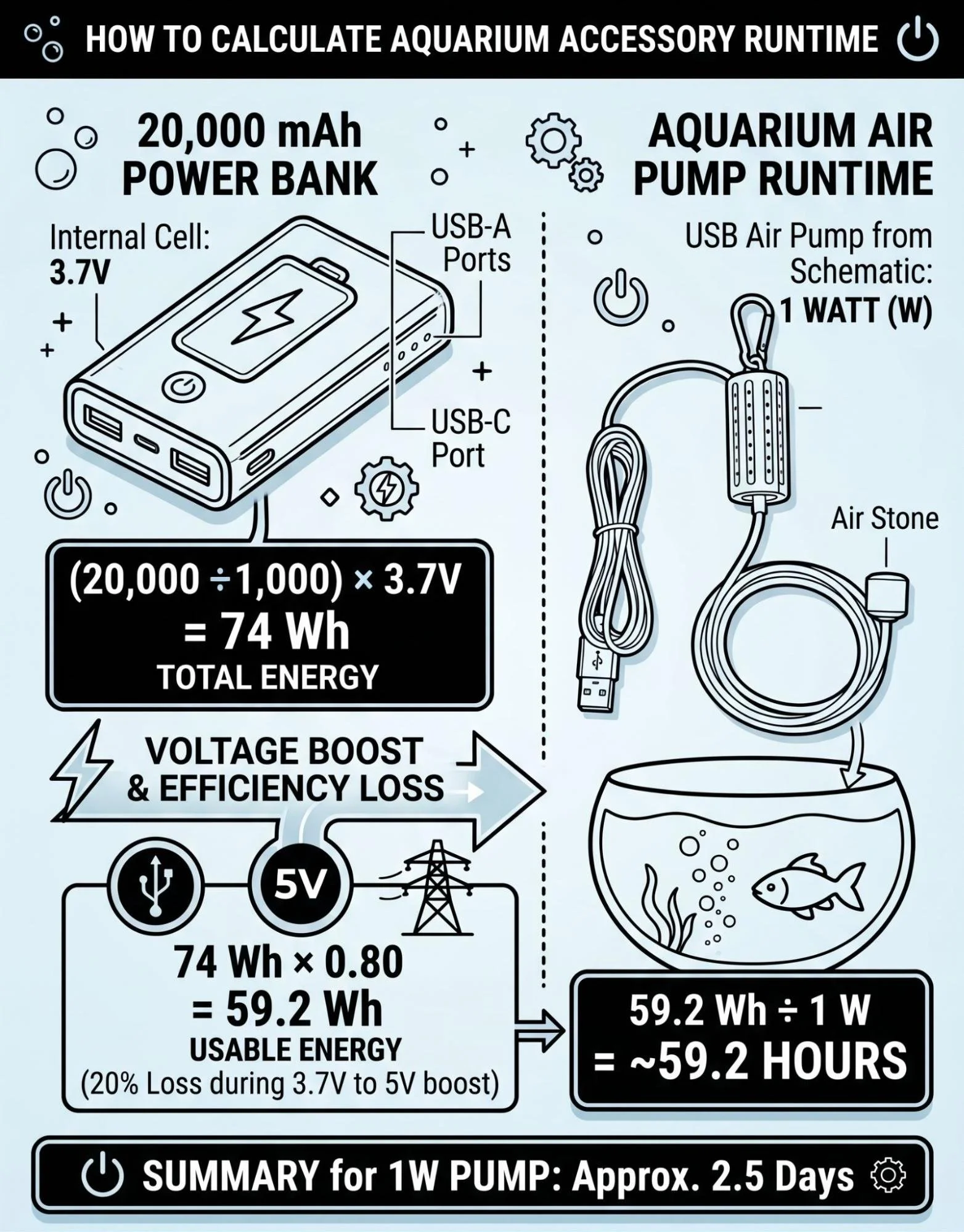
A USB power bank is a portable battery you can use to charge USB devices. These devices are rated by mAh (Milliampere-hours) which measures charge capacity. Power banks with larger mAh ratings (e.g. 20,000 mAh vs 10,000 mAh can power devices longer.
USB Power Banks are inexpensive ($15 to $50) and you may already have one, so they are a great backup option.
To calculate how long (e.g.) your USB air pump will last, see the illustration below.
Power Tool Batteries as Power Banks
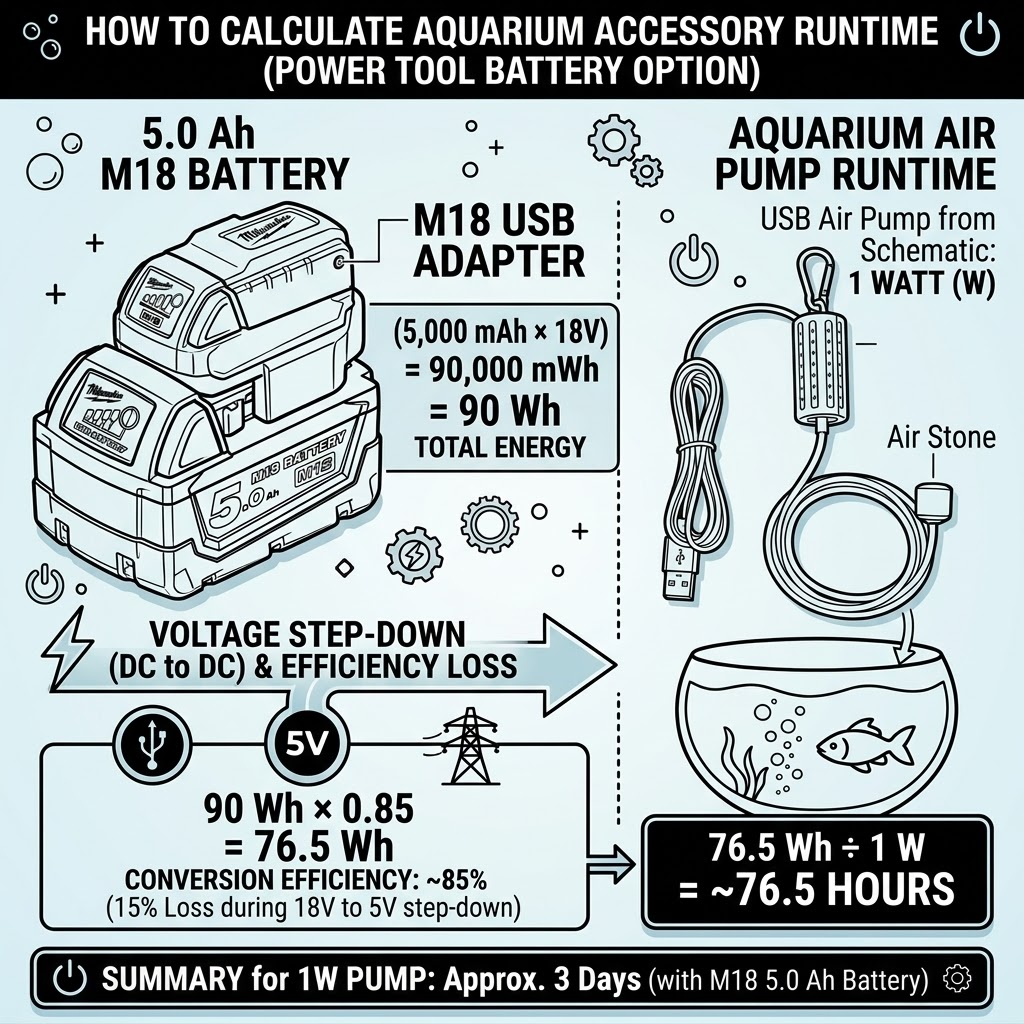
Adapters are available for most brands of power tools such as Milwaukee, Dewalt and Craftsman which convert a power tool battery to a USB power bank.
Power tool batteries have enormous capacity and, since you may already have them, they are a great backup option.
I use Milwaukee power tools and have several M18 batteries. The calculation for run time is different from that of a power bank.
Battery Backed Air Pumps
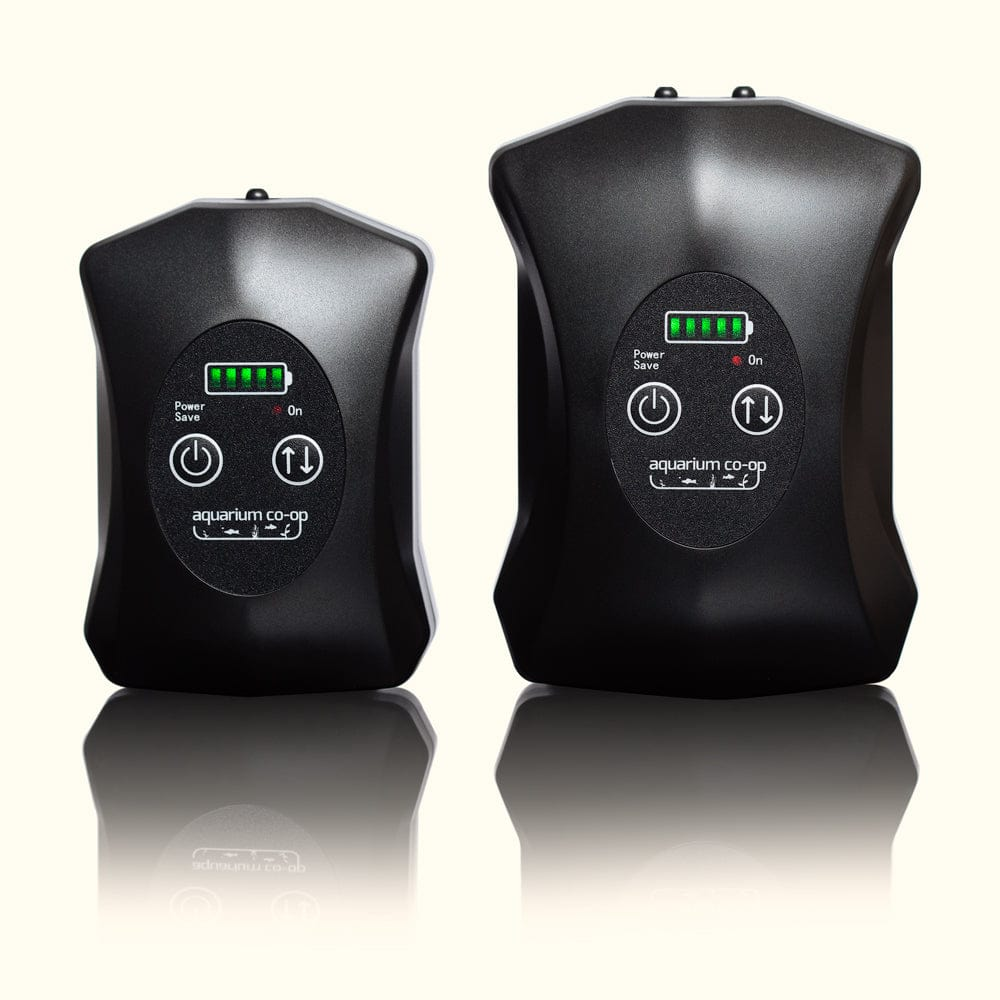
If you employ air-driven filtration such as a sponge filter, a simple and flexible solution is to switch out your ordinary air pumps for battery backed units.
These pumps include a rechargeable battery which switches to battery when the power goes out. More sophisticated units offer an intermittent timer function to cycle on and off at set intervals extending battery life up to 40 hours.
Several vendors offer battery backed air pumps such as Aquarium Co-op.
The Aquarium Co-op pumps are notable in that they actually run off of 5V USB internally. They can be plugged into USB power banks to extend their life.
Portable Power Stations
A portable power station is a rechargeable, all-in-one battery system that stores electricity to provide battery backup. Power is delivered through outlets for 110V AC, USB-A and USB-C ports, and 12-volt car sockets. To charge the power station, simply plug it into a 110V outlet, a 12V outlet on your car or a solar panel.
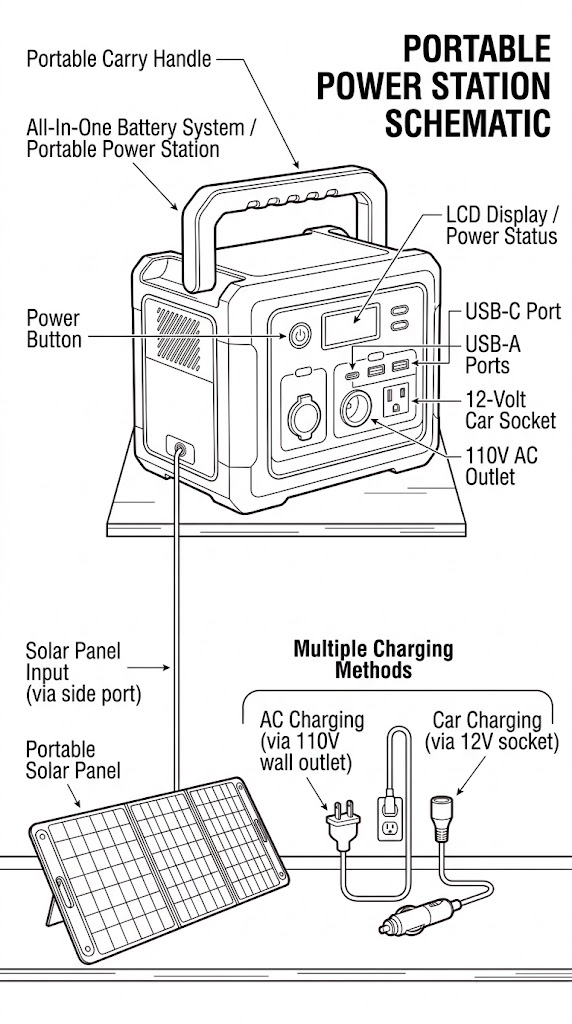
These systems act as an Uninterruptible Power Supply (UPS). When the power goes out, power is delivered until the battery power is depleted. When the power resumes, charging automatically begins.
The ability to charge via a solar panel can take advantage of Florida’s abundant sunshine allowing you to recharge the power station before electrical service is restored.
Larger capacity Portable Power Stations are a good choice for fish rooms which use central air systems. For example, to backup a linear piston pump which provides air to multiple tanks.
Sizing your Portable Power Station
Before buying a Power Station, calculate how much power you will need using the diagram below:
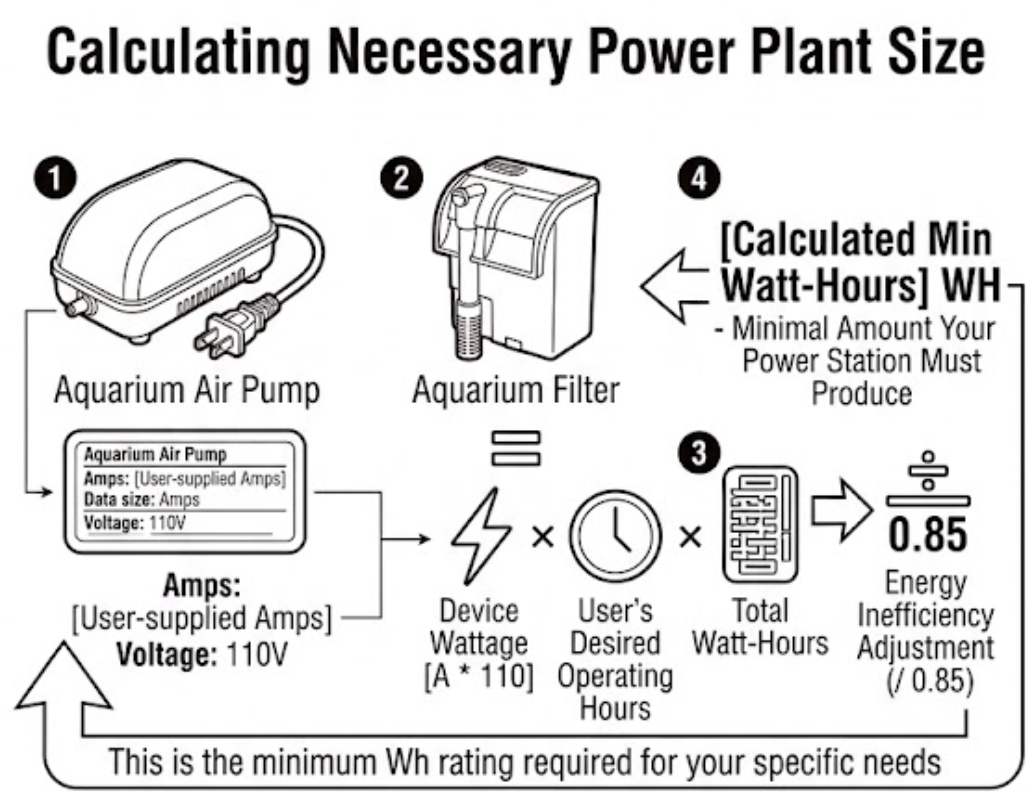
Using an Intermittent Timer with a Power Station
An intermittent timer can extend your overall aquarium life support plan by turning on and off air pumps or filters repeatedly in a specific pattern.
For example, you could turn your air pump on for 10 minutes, then off for 20 minutes and repeat the cycle. This provides adequate aeration for life support and extends battery life.
The BN Link Intermittent Timer (Amazon Link) makes it easy to set up a pattern like this and allows you to extend overall run time by a factor of three.
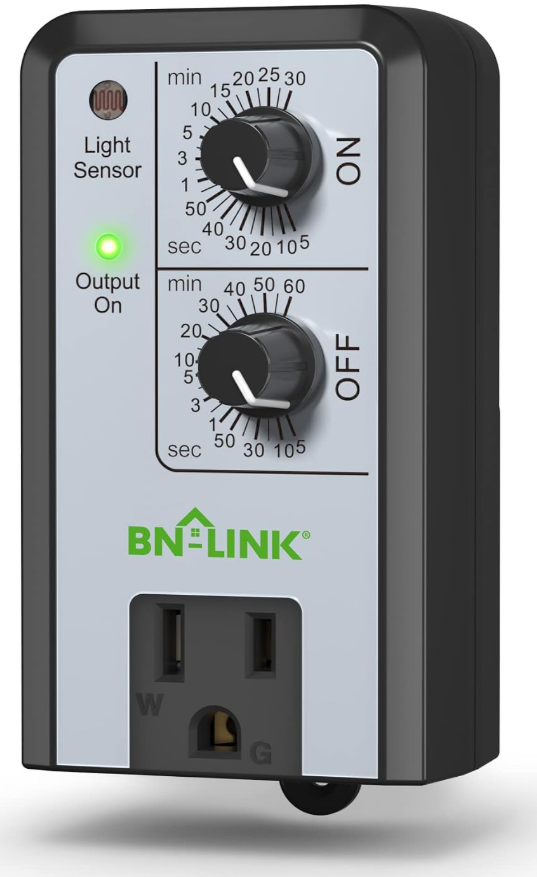
Unfortunately, I do not know of an intermittent timer that automatically switches from non-intermittent to intermittent mode when the power goes out. You will have to plug in your intermittent timer when the power goes out.
Canister Filters: A Warning
WARNING: Never allow a canister filter that has been powered off for more than two hours to restart directly into your aquarium. Running a stagnant canister flushes lethal hydrogen sulfide gas, toxic ammonia, and oxygen-starved water into the tank, which can wipe out your livestock within minutes. Always disconnect, thoroughly drain, and rinse the filter media with fresh, dechlorinated water before reconnecting power.
A stagnant canister filter has a strong “rotten egg” smell.
When the power goes out, unplug the canister filter if you do not have backup power to run it.
Empty water from the canister filter and flush and clean the filter media.
Purge water from the intake and return lines
External Power Filters: Caution
External power filters can have some of the same issues as canister filters. Fortunately, external filters are not sealed to outside air which lowers the risk.
To be safe, unplug external power filters during power interruptions and rinse all filter media before returning them to service.
Backing up a Florida Fish Room: My experience
I run an Alita linear piston pump in my fishroom as the central air source. This pump draws 45 watts of power and powers 30+ air outlets for my 17 tanks.
I purchased a Bluetti EL100v2 Power Bank which has a capacity of 1024 watt hours. Separately, I purchased two, 100W solar panels. To extend run time, I use an intermittent timer which is set to run 10 minutes on, 20 minutes off.
So, how long can I run using this setup?
With a standard 1024Wh battery, I can keep the fish room aerated for over 28 continuous hours purely on stored power. Connecting my solar panels really changes the equation because on an average day here in Cape Coral I can gain an average of 700+ Watt Hours of energy.
Thus, on a sunny day, I can capture more power than needed to run the linear piston pump on the intermittent duty cycle.
I am prepared for a multi day off-grid situation.
Set-up and Installation
My Bluetti Power Bank and Linear Piston Pump are housed next to each other on a lower shelf in my fishr oom. Even though my fish room is on an outside wall, I would need over 50 feet of solar cable to connect my panels.
I drilled through the concrete wall of my garage fish room so that I could run cable directly to a sunny spot in the backyard.
To create a neat installation, I used a Solar Gland– which is essentially a specialized outlet for solar connection cables– on the inside of my fish room and outside of my garage.
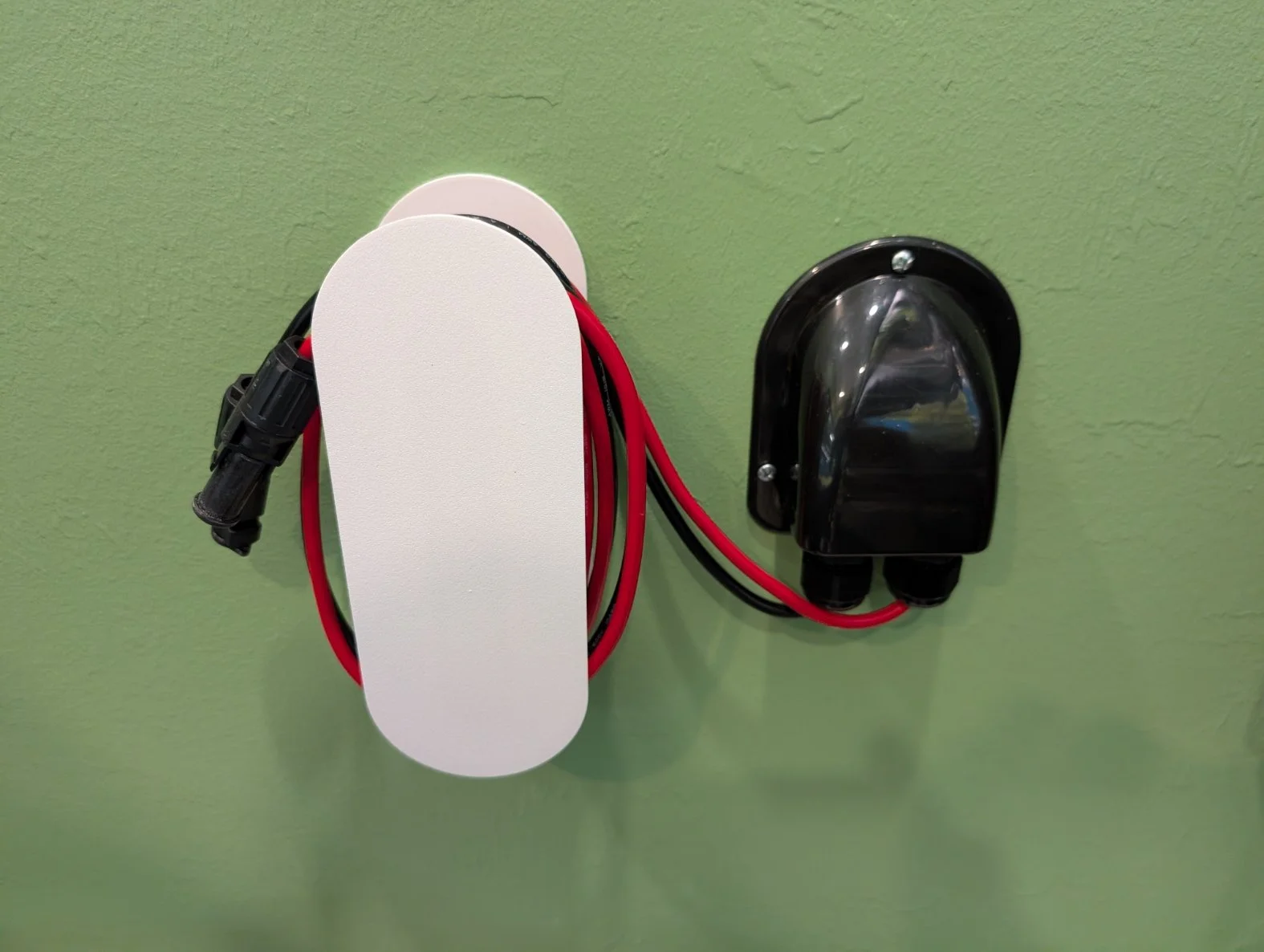
How much did it cost to set this up?
Bluetti Power Station EL100V2 - $400
VEVOR 100W Bifacial Solar Panel (2) - $188
BN Link Intermittent Timer - $27
Solar Glands, Solar Extension Cables - $60
Total - $675
Last Thoughts
Plan now for power disruptions which are frequent in Florida.
Buy, install and test your preferred solution.
If the power goes out:
Unplug canister filters and power filters
Discontinue feeding your fish.
If power is out for more than 3-4 days, feed only very lightly.
